
You eat well, take your supplements, and avoid junk food—but something still feels off. You’re tired, your hair’s thinning, and your brain feels foggy. What gives? Even if you are living a healthy lifestyle, there are essential nutrients for anti aging that everybody needs to feel their best. In this post, we will go over what those nutrients are, how you can (and should) have your levels tested with a standard blood draw, and how to improve deficiencies.
As we age, our ability to absorb essential nutrients declines—even if we’re eating the right foods. The result? Subtle deficiencies that speed up the aging process from the inside out.
This is where functional nutrition meets anti-aging. By focusing on nutrient absorption, not just nutrient intake, you can optimize how your body uses food to maintain energy, brain clarity, strong muscles, and vibrant skin. In short, it’s one of the most overlooked strategies in any anti-aging routine.
🚨 What to Watch For: Subtle Signs of Deficiency
Deficiencies in micronutrients often sneak up on us. The symptoms are common, but when several cluster together, it’s a red flag:
- Hair thinning or loss
- Muscle cramps or twitching
- Fatigue, depression, or low mood
- Brain fog or poor memory
- Weak nails or dry, irritated skin
While these may be written off as “just getting older,” they’re often the result of low levels of key micro nutrients and macro nutrients—and they’re reversible.
🧪 Labs to Run: Get the Full Picture
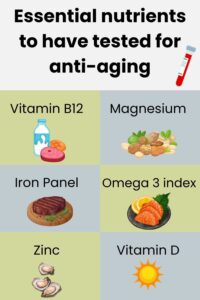
You can’t correct what you don’t measure. Here are six labs that reveal whether your body is actually absorbing and utilizing the essential nutrients it needs to slow down the aging process. You can ask your doctor to have these drawn as part of your routine medical care, or you can order these labs for yourself. If you need help ordering labs, I am happy to offer lab testing here. The process is simple – just order, get your blood drawn at a Quest location near you, and receive results!
1. Vitamin B12
Vital for nerve function, energy production, and mood regulation. Deficiencies are especially common in people over 50 or those taking acid-reducing medications.
- What to watch for: fatigue, numbness, memory issues
- Pro tip: Methylated B12 (methylcobalamin) is often better absorbed
- Dietary sources include red meat, fish, poultry, eggs and dairy
2. Magnesium (RBC Magnesium preferred)
This “master mineral” supports over 300 enzymatic reactions including those related to sleep, stress, and metabolism.
- What to watch for: muscle cramps, anxiety, poor sleep
- Pro tip: Use Epsom salt baths and magnesium glycinate for relaxation and improved sleep
- Optimal ranges are 6-6.8 mg/dl
- Check out this post for a deep dive on Magnesium deficiency
3. Iron Panel (Iron, TIBC, Ferritin, % Saturation)
Iron is essential for oxygen transport and energy. But too much or too little can both cause health issues.
- What to watch for: fatigue, pale skin, cold hands/feet
- Pro tip: Cook in cast iron pans and pair iron-rich foods with vitamin C
- Optimal iron levels are 85-130 ug/dl; optimal Ferritin is 30-70 ng/ml.
- Increased Ferritin levels can indicate oxidative stress or inflammation
- Low Ferritin levels can be a root cause of thinning hair
4. Omega-3 Index
Measures your levels of essential fatty acids EPA and DHA, which reduce inflammation and support heart and brain health. Indexes of 8-12% are associated with better cognitive function, improved arthritis symptoms, and reduced depressive symptoms.
- What to watch for: dry skin, poor memory, joint pain
- Pro tip: Eat wild salmon/fatty fish 3x/week, flax, chia, or take a high-quality fish oil
- Check out my favorite Omega-3 supplement here
5. Zinc
Essential for immune function, skin repair, thyroid function and hormone balance.
- What to watch for: slow wound healing, skin issues such as acne, low libido
- Pro tip: Pumpkin seeds, hemp seeds, and shellfish are great sources
- Check out this post for more information on zinc deficiency
6. Vitamin D (25-Hydroxy D Test)
Vitamin D supports immune function, bone health, and mood stability. Low levels are linked to faster cellular aging and increased disease risk.
- What to watch for: frequent illness, low mood, bone pain or weakness
- Pro tip: Get safe sun exposure and consider a D3 + K2 supplement if levels are low (I prefer the drops by Seeking Health)
- Did you know? While the standard range is 30-100 ng/dl , optimal range is 50-90 ng/dl.
- Check out this post for more details on Vitamin D deficiency.
If you are looking for a source for quality, practitioner grade supplements, join my Fullscript Dispensary and get 25% off!
🌱 Lifestyle Strategies: Improve Absorption, Not Just Intake
It’s not just what you eat—it’s what your body can absorb and use. Here’s how to upgrade your anti-aging nutrition strategy:
✅ 1. Rotate Food Sources
Eating the same foods daily can lead to gaps and imbalances. Rotate greens, proteins, and healthy fats to maximize micro nutrient diversity.
✅ 2. Choose Methylated Supplements
Especially for B vitamins, choosing “methylated” forms improves bioavailability—meaning your body uses them more effectively.
✅ 3. Use Cast Iron Pans
Cooking in cast iron naturally boosts the iron content of your food—especially helpful for menstruating women or those with low ferritin.
✅ 4. Soak in Epsom Salts
A warm Epsom salt bath delivers magnesium through the skin and supports muscle recovery, relaxation, and detoxification.
✅ 5. Avoid Nutrient Blockers
Certain habits can prevent your body from absorbing nutrients well. Cut back on:
- Antacids or acid blockers (they reduce stomach acid needed for absorption)
- Excess caffeine (can deplete magnesium)
- Alcohol (disrupts nutrient metabolism)
🔄 Why This Matters for Anti-Aging
When your cells are starved of essential nutrients, they can’t repair, regenerate, or protect themselves effectively. This accelerates aging at the cellular level—leading to earlier signs of fatigue, disease, and hormonal imbalance.
But when your body is well-nourished and absorbing what it needs, everything improves: your skin glows, your brain sharpens, and your energy increases. Think of it as the foundation for every other anti-aging practice you use—whether it’s hormone balancing, exercise, or skin care.
👊 Final Thoughts
Don’t assume that eating “clean” means you’re fully nourished. Functional aging starts with nutrient awareness—knowing what to monitor, which labs to run, and how to fine-tune your diet and supplements to meet your body’s changing needs.
By focusing on absorption and the right essential nutrients, you can give your body the tools it needs to thrive—at every age.
Check out some of my other posts on anti-aging strategies:
How to boost your metabolism as you age
Labs you need to combat inflammation
Disclaimer
These statements have not been evaluated by the Food and Drug Administration. This is not intended to diagnose, treat, cure or prevent any disease. This information is for educational purposes only, please consult with your medical provider before implementing anything new into your daily regimen.